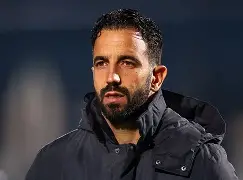
Ruben Amorim issued a stark warning to Manchester United’s board to “do their job” following a gritty 1-1 draw at Leeds United on Sunday, making clear he expects no interference in his work. The 40-year-old Portuguese’s fiery press conference cast fresh shadows over his future at Old Trafford, exposing potential rifts amid the club’s persistent struggles. With United mired outside the Premier League top four, Amorim’s push for broader control highlights a power struggle in a storied institution still grappling with its post-glory malaise.
Amorim’s bluntness came when pressed on his confidence in the hierarchy, a topic he had dodged pre-match while sidestepping questions on transfer plans. “Guys, to start with that, and I noticed that you receive selective information about everything, I came here to be the manager of Manchester United, not to be the coach of Manchester United,” he stated. “And that is clear. I know that my name is not (Thomas) Tuchel, it’s not (Antonio) Conte, it’s not (Jose) Mourinho but I’m the manager of Manchester United. And it’s going to be like this for 18 months or when the board decides to change, so that was my point.”
He ruled out resignation: “I want to finish with that. I’m not going to quit. I will do my job until another guy is coming here to replace me.” Reports point to tactical meddling, with head of recruitment Christopher Vivell reportedly urging Amorim to adjust after Fulham’s Marco Silva dissected his setup during their August draw. Amorim shifted from his preferred three-man defence for a win over Newcastle but returned to it for flat draws against Wolves and Leeds. Disagreements over transfers and tensions with director of football Jason Wilcox add to the strain.
Amorim, installed as head coach—not manager—after Erik ten Hag’s November 2024 sacking, hammered the title distinction. “I just want to say that I’m going to be the manager of this team, not just the coach,” he insisted. “I was really clear on that and that is going to finish in 18 months and then everyone is going to move on. That was the deal. That is my job. Not to be a coach. In every department – the scouting department, the sporting director – needs to do their job. I will do mine for 18 months and then we move on. If people cannot handle the Gary Nevilles and the criticisms of everything, we need to change the club.”
This clash unfolds against Manchester United’s deepest historical fault lines, a far cry from the dominance of the Sir Alex Ferguson years. From 1986 to 2013, Ferguson built an empire: 13 Premier League titles, two Champions Leagues, five FA Cups, and four League Cups, turning United into global football’s richest brand. His 2013 retirement, after clinching that final league crown, marked the end of an era—but the beginning of chaos.
David Moyes lasted 10 months in 2014, finishing seventh. Louis van Gaal followed with a 2016 FA Cup but was axed after fourth place. Jose Mourinho delivered Europa League glory in 2017 and a second-place finish, yet departed amid boardroom friction in 2018. Ole Gunnar Solskjaer’s interim heroics faded into a 2020-21 second place, soured by heavy defeats. Ralf Rangnick’s 2022 interim stint bridged to Ten Hag, whose 2024 FA Cup win masked a slide to 15th last season and a Europa League final defeat to Tottenham.
The Glazer era, launched with their debt-fuelled 2005 buyout, amplified woes—fan revolts peaked in 2021 over the failed European Super League. Sir Jim Ratcliffe’s 2023 minority investment and football operations overhaul brought Wilcox and Vivell, yet United linger titleless since 2013, their worst top-flight finish ever last term. Amorim, fresh from Sporting Lisbon triumphs that marked him as Europe’s rising star, now battles to impose his vision under contract until 2027.\
Brenden Aaronson put Leeds ahead in the second half, flirting with United’s first league loss to them since 2002, until Matheus Cunha levelled minutes later. The result spared outright humiliation but did little to quell scrutiny on Amorim, whose early promise has dimmed.
His remarks echo predecessors’ plaints against interference, from Mourinho’s Ed Woodward barbs to Ten Hag’s squad pleas. As United eye top-four salvation, Amorim’s 18-month horizon tests Ratcliffe’s regime: empower the manager, or perpetuate the cycle?
Leave a Reply
You must be logged in to post a comment.