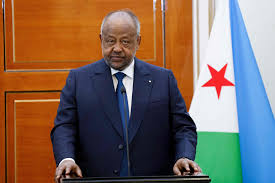
Djibouti’s long-serving president, Ismail Omar Guelleh, is set to extend his 26-year rule after accepting to contest for a sixth term in the country’s next presidential election, following the removal of a constitutional age limit that previously barred him from running.
The 77-year-old leader, who has been in power since 1999, reportedly agreed to run again after a congress of the ruling People’s Rally for Progress (RPP) endorsed him as the party’s flag bearer. The development came days after Djibouti’s parliament voted to scrap the 75-year age cap for presidential candidates.
“He has agreed to be a candidate in next year’s presidential election. Everything went smoothly,” said Dileita Mohamed Dileita, President of the National Assembly, confirming the decision to AFP.
Although an official statement from the presidency is yet to be released, another participant at the RPP congress, who requested anonymity, also confirmed Guelleh’s decision to run.
Guelleh’s return to the race places him among Africa’s ageing leaders who continue to extend their stay in office a list that includes Cameroon’s 92-year-old Paul Biya and Ivory Coast’s 83-year-old Alassane Ouattara.
With his party’s strong grip on parliament and state institutions, Guelleh’s re-election appears almost certain. He secured 97 percent of the vote in the 2021 election while his coalition, the Union for the Presidential Majority, dominates the legislature.
However, international observers and rights groups have repeatedly questioned the credibility of Djibouti’s elections. The International Federation for Human Rights (FIDH) has described past polls as “not free,” citing restrictions on opposition candidates and widespread control of the media.
Djibouti ranks 168th out of 180 in the 2025 World Press Freedom Index by Reporters Without Borders (RSF), which said, “the media landscape is completely controlled and limited almost exclusively to state media.”
Despite criticism, Guelleh’s government has maintained a reputation for stability in the Horn of Africa, a region often shaken by conflict. Djibouti’s location along the Bab el-Mandeb Strait, one of the world’s most vital trade routes, gives it enormous geopolitical value. The tiny nation hosts military bases for global powers including the United States, France, China, Japan, and Italy.
Guelleh, who succeeded Hassan Gouled Aptidon the father of Djibouti’s independence, has maintained close ties with these nations, balancing global interests while consolidating power at home.
Speaking earlier this year with Africa Report, the president hinted at his willingness to continue leading, saying, “All I can tell you is that I love my country too much to embark on an irresponsible adventure and be the cause of divisions.”
He also brushed aside health concerns that have surfaced in recent months. “I probably need to lose a few pounds,” he admitted with a laugh, before adding, “Otherwise, everything is perfect.”
This is not the first time Djibouti has adjusted its constitution to accommodate Guelleh’s political ambitions. In 2010, lawmakers amended the law to remove the two-term limit, effectively paving the way for his continued rule.
Leave a Reply
You must be logged in to post a comment.