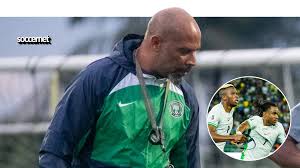
Super Eagles head coach Eric Chelle dropped a 55-man provisional roster for the 2025 Africa Cup of Nations on Tuesday, pulling together a deep pool of talent as Nigeria turns the page from its bruising World Cup qualifying exit.
The Nigeria Football Federation pushed the list across its official channels, spotlighting a core of battle-tested pros like captain William Troost-Ekong, Napoli loanee Victor Osimhen, Leicester City’s Wilfred Ndidi, and Chippa United shot-stopper Stanley Nwabali. Chelle layered in homegrown standouts too, with Nigeria Premier Football League aces Abdulrasheed Shehu of Niger Tornadoes, Ekeson Okorie from Nasarawa United, and Chisom Orji of Rangers International making the cut after consistent showings in domestic action. Six keepers head the pack – Nwabali, Amas Obasogie, Maduka Okoye, Adebayo Adeleye, Francis Uzoho, and teenage prospect Ebenezer Harcourt – followed by 13 defenders, 12 midfielders, and a hefty 23 forwards that includes Ademola Lookman of Atalanta, Samuel Chukwueze at AC Milan, and Bayer Leverkusen’s Victor Boniface.
Chelle, the Franco-Malian tactician who took the reins in mid-2024 after Finidi George’s short stint, faces a tight deadline to shave this down to the tournament’s 28-player limit by December 11, per Confederation of African Football rules. The selection nods to his preference for blending overseas firepower with local grit, a formula that echoes the Eagles’ build-ups under past handlers like Gernot Rohr, who leaned on similar mixes during the 2019 and 2021 campaigns.
This call-up lands just weeks after the sting of November 16, when DR Congo nicked a 4-3 penalty-shootout win over Nigeria in Rabat’s Prince Moulay El Hassan Stadium, following a 1-1 draw that stretched into extra time. Frank Onyeka had put the Eagles ahead early in that CAF playoff final, only for Mechak Elia to level things before substitute keeper Timothy Fayulu’s heroics sealed Congo’s path to March’s inter-confederation playoffs. The loss marked Nigeria’s second straight World Cup absence, a far cry from the six editions the three-time African champions reached between 1994 and 2018.
Nigeria’s World Cup qualifying odyssey traced a rocky path through 2024 and into 2025. The Eagles topped their group with seven points from four matches but stumbled in key ties, including a 1-0 home blank against Lesotho and a 3-2 away slip to Benin Republic. Those stumbles dropped them to second place behind Rwanda, funneling them into the playoffs where they first dispatched South Africa on penalties before Congo’s edge ended the run. Public records from CAF show Nigeria logging 12 goals scored against nine conceded across the group stage, yet defensive lapses and missed chances proved costly in the crunch.
The fallout rippled quickly. On November 17, the NFF issued a public apology to President Bola Tinubu, the federal government, and fans, acknowledging in an official release that “our collective effort did not deliver the outcome this nation deserved.” The federation pledged an internal review of the campaign, citing logistical hitches and preparation gaps as factors, though no timeline for findings emerged. Former captain John Mikel Obi, speaking on his Obi One Podcast days later, laid the blame squarely on administrative shoulders, calling out “mismanagement and corruption” in a segment that drew over a million views on social media.
Tinubu, in a statement via his special adviser Bayo Onanuga, praised the players’ grit while steering eyes forward: “Notwithstanding the unfortunate loss, we must commend the players for their efforts and continue to support them.” He pressed for a full pivot to AFCON, adding that “our Super Eagles must recover the lost glory.” Labour Party chieftain Peter Obi echoed the call for resilience in a public post, urging the squad with the line: “the Eagle never bows its head.”
AFCON 2025, the 35th instalment since Ethiopia hosted the inaugural tournament in 1957, shifts to a winter slot this time around – running from December 21, 2025, to January 18, 2026, in Morocco. The hosts snagged the rights on September 27, 2023, marking their second go after 1988, with nine venues across six cities like Casablanca’s Mohammed V Stadium and Rabat’s Ibn Batouta set to host the action. CAF’s expanded 24-team format, locked in since 2019, splits sides into six groups of four; the top two plus the four best third-placers advance to knockouts.
Nigeria slots into Group C alongside Tunisia’s Carthage Eagles, Uganda’s Cranes, and Tanzania’s Taifa Stars – a draw pulled in Johannesburg on July 4, 2024. The Eagles open against Tanzania on December 23 in what shapes as a winnable start, given their 1-0 group-stage win over the East Africans in 2023 qualifiers. Historical edges run deep here: Nigeria holds a 5-2-1 record against Tunisia since 1994, including a 4-2 thrashing in the 2010 Nations Cup semis, while they’ve blanked Uganda 3-0 in their last three meetings dating back to 2019.
Preparations ramp up with a camp opening in Cairo, Egypt, on December 10, where the provisional picks converge for drills and a high-stakes friendly against the Pharaohs four days later at Cairo International Stadium. NFF logs show this setup mirrors past builds, like the 2023 Ivory Coast camp in Dubai, aimed at syncing jet-lagged stars under coach Jose Peseiro. From there, the Eagles jet to Morocco, with CAF mandating arrival by December 18 for final checks.
Leave a Reply
You must be logged in to post a comment.