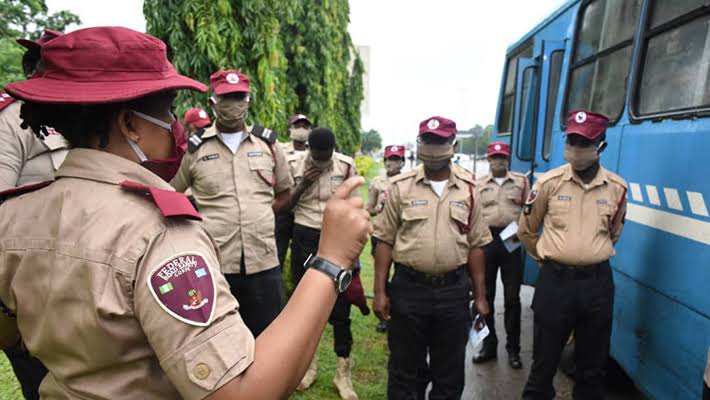
In a landmark ruling, the Court of Appeal sitting in Owerri, Imo State, has declared that the Federal Road Safety Corps (FRSC) lacks the authority to seize drivers’ licenses, vehicles, or related documents without lawful justification. The court upheld a lower court’s decision, affirming that such seizures violate fundamental human rights, and ordered the FRSC to pay N10 million in damages to a Nigerian motorist, Dr. Emmanuel Ugochukwu Shebbs.
The unanimous judgment, delivered on June 27, 2025, by Justices Amina Audi Wambai, M. Lawal Abubakar, and Ntong F. Ntong, resolved Appeal No: CA/OW/199/2022. The case pitted the Federal Road Safety Commission, its Corps Marshal, and an FRSC officer (Appellants) against Mr. Shebbs Emmanuel Ugochukwu (Respondent). While affirming the FRSC’s liability for human rights violation, the appellate court reduced the initial N30 million damages awarded by the High Court of Abia State to N10 million, covering general and exemplary damages.
The enrolled order, signed by Suobo Zuofa Esq. for the Deputy Chief Registrar, explicitly stated that “the decision of the lower court adjudging the Appellants as having violated the fundamental human rights of the Respondent is affirmed.”
Five-Year Legal Battle Rooted in COVID-19 Lockdown Incident
The legal battle began five years ago, in 2020, during the COVID-19 pandemic lockdown. Dr. Shebbs recounted that FRSC officers stopped him along Bende Road in Umuahia on a Saturday, a designated day for residents to restock essentials. After initially checking his vehicle documents and safety items, which were all in order, an officer allegedly solicited “something” (money).
“At that moment, I had no cash on me,” Shebbs explained. He further described how, upon his inability to offer money, the officers “suddenly embarked on a second round of inspection; this time, ransacking my car.” This led to a new set of “offences” being cited, such as “worn out tire or no spare tire,” turning a casual stop into a traffic offense.
Shebbs stated that he was issued a N3,000 fine and his driver’s license was retained. Despite having options to “do it the Nigerian way” by leveraging connections or simply paying the fine, he chose to pursue legal action.
“I remembered the many Nigerian youths who neither had connections nor ID Cards; those who couldn’t afford to ‘pay their way out’ of an abusive law enforcement system,” he stated. “I remembered the many youths whose vehicles, papers, and licenses have been unlawfully confiscated by some abusive officers, who weaponize their uniforms against innocent youths contrary to the law.”
Judicial Precedent for Human Rights
For Dr. Shebbs, the case was never about the money but about establishing a crucial judicial precedent. “It’s about the judicial precedent now established in FRSC & Anor v. Shebbs, that the seizure of a driver’s licence, vehicle, or related documents without lawful justification is a breach of fundamental rights. This is my humble contribution to the development of Human Rights Law in Nigeria,” he affirmed.
He emphasized the significance of the ruling, stating, “The Appeal Court has ruled that Road Safety does not have the right to seize documents and properties of road users unless they intend to charge you to court.”
Dr. Shebbs urged Nigerians to demand their properties seized unlawfully by the FRSC, proclaiming, “The Appeal Court has broken the fetters of injustice in the Road Safety operations.”
Leave a Reply
You must be logged in to post a comment.