Tag: Political Parties

  • 2027: INEC Unveils Draft Guidelines For Political Parties

    2027: INEC Unveils Draft Guidelines For Political Parties


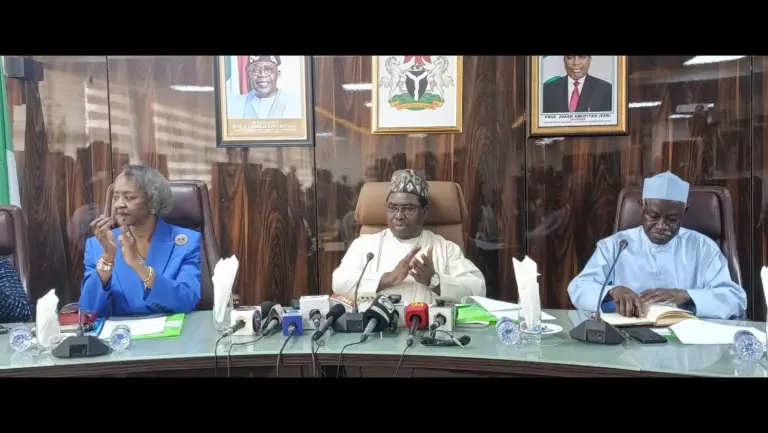
    Independent National Electoral Commission (INEC) on Tuesday unveiled the draft 2026 Regulations and Guidelines for Political Parties to align with the enactment of the Electoral Act 2026.

    INEC Chairman, Prof. Joash Amupitan, did the unveiling at the consultative meeting with leaders of political parties on the review of INEC Regulations and Guidelines for Political Parties in Abuja.


    Amupitan said that the review became necessary following the enactment of the Electoral Act 2026.

    According to him, Nigeria cannot navigate a 2027 horizon using a 2022 map.Nigerian Politics Book

    Amupitan called on political parties to take special note of Clause 40(4) & (5) of the draft regulation dealing with election expenses of political parties for the management of party primaries and for the conduct of elections.

    He said that INEC had concluded a clause-by-clause realignment of its guidelines to ensure that they were not only legally air-tight but operationally in sync with the new Act.

    “Our review has been guided by empirical data; specifically, findings from the Political Party Performance Index (PPPI).

    “This diagnostic tool, developed with the support of the Westminster Foundation for Democracy (WFD), highlighted a disturbing gap between party constitutions and grassroots realities.


    “The newly drafted regulations encompass crucial areas that are central to the operations of political parties in our democratic framework, including registration and merger of political parties.

    “We have streamlined the process to ensure that it is more accessible, while maintaining a robust framework that upholds democratic principles,” he said.

    On political party operations, Amupitan said that clear guidelines had been instituted to govern the day-to-day functioning of political parties, ensuring compliance with the country’s laws and promoting accountability.


    “This aims to sanitise party primaries, which intends to end the era of opaque processes that impose unpopular candidates, fueling voter apathy and a deluge of avoidable litigation.

    “We recognise the critical role of primary elections in our political system. Thus, we have outlined procedures that uphold fairness and transparency within political parties,” he said.

    Amupitan added that regulations had also been put in place to ensure that campaign activities were conducted peacefully and respect the rights and dignity of all citizens.

    “We have established clear standards regarding the financing of political activities, emphasising the need for transparency and accountability in managing party funds and campaign expenses.

    “We have also included provisions that define the circumstances under which a political party may be deregistered, ensuring that the process is just and equitable.

    “We have also included provisions that define the circumstances under which a political party may be deregistered, ensuring that the process is just and equitable.

    “We have also embedded measurable benchmarks for the participation of women, youth, and persons with disabilities (PWDs),” he said.

    The INEC chairman urged political parties not to see the draft regulations as a restriction, but as a safeguard.

    In his remarks, the National Chairman of IPAC, Yusuf Dantalle, called on the National Assembly to urgently amend the 2026 Electoral Act to prevent it from jeopardising the 2027 polls.

    Dantalle argued that while Nigerians participated in public hearings with high expectations, the final Act represented a regression that inadvertently placed immense pressure on political parties, especially those outside government.

    “IPAC firmly demands that the National Assembly, as a matter of urgency, revisits and amends the Electoral Act 2026.

    “Specifically, the provision mandating direct primaries must be reconsidered, and the option of indirect primaries restored.

    “The choice of candidate selection methods remains an internal affair of political parties,” he said.

    Discover more
    High speed internet services
    Disaster preparedness kits
    Cryptocurrency investment guides
    Nigerian Business Directory
    News Article Syndication
    The IPAC chairman also described the requirement for parties to submit membership registers—including National Identification Numbers (NIN)—between April 1 and April 21 as “impractical and exclusionary.”

    He warned that the provision risked disenfranchising millions of Nigerians who lacked access to NIN registration facilities.

    Dantalle also demanded the restoration of mandatory electronic transmission of results to the INEC Results Viewing (IReV) portal immediately after polling unit announcements, without any provision.

    “It is also deeply troubling that the new Electoral Act appears to weaken penalties for vote buying.

    “IPAC reiterates its call for the establishment of an Electoral Offences Commission to ensure violators are held accountable,” he added.

    Dantalle stated that the council had already appealed to the National Assembly to repeal the Act in the interest of a credible and transparent electoral process.

    (NAN)
  • INEC Ramps Up Preparations for FCT Area Council Polls with Mock Accreditation Drill

    INEC Ramps Up Preparations for FCT Area Council Polls with Mock Accreditation Drill


    As the Federal Capital Territory (FCT) gears up for its Area Council elections later this month, the Independent National Electoral Commission (INEC) is taking proactive steps to ensure a seamless electoral process. The commission has launched a mock accreditation exercise designed to address potential glitches in voter verification and results transmission, underscoring its commitment to a smoother experience for voters on election day.

    Scheduled for Saturday, February 7, 2026, the mock drill will run from 8:30 a.m. to 2:30 p.m. across 289 polling units in the FCT. INEC’s Resident Electoral Commissioner for the territory highlighted the importance of public involvement, urging residents in these selected areas to participate by bringing their Permanent Voter Cards (PVCs). This exercise is crucial in refining the electoral process ahead of the main elections on February 21. A full list of the polling units involved is available on INEC’s official website, where voters can check their eligibility and find their polling locations.

    This mock accreditation drill is part of INEC’s broader efforts to ensure a credible and transparent election. Voters in the FCT will cast their ballots to elect chairmen and councillors for the six Area Councils: Abaji, Abuja Municipal, Bwari, Gwagwalada, Kuje, and Kwali. Unlike local government elections in Nigeria’s 36 states, which fall under State Independent Electoral Commissions, the FCT elections are directly managed by INEC. This is due to the FCT’s status as a federal entity without a state governor. This arrangement was established by the 1976 Local Government Reforms under General Murtala Mohammed’s military regime and later enshrined in the 1999 Constitution, making the FCT’s Area Councils equivalent to local governments in other states.

    A key feature of the mock exercise is testing the Bimodal Voter Accreditation System (BVAS), a technology INEC has progressively refined. BVAS was first deployed in the off-cycle governorship elections in Anambra, Ekiti, and Osun states in 2021 and 2022. Nationwide mock exercises, such as the one conducted on February 4, 2023, across 436 polling units in 109 senatorial districts, have demonstrated significant improvements in BVAS functionality. These improvements include faster facial and fingerprint recognition, which have been observed by Situation Room observers as a positive advancement compared to earlier deployments.

    For the upcoming FCT polls, INEC plans to deploy over 3,000 BVAS devices, including backups, to handle voter accreditation for the 1,680,315 registered voters across 2,822 polling units. This figure reflects an increase in registered voters from 1,570,307 in 2023, a testament to ongoing voter registration efforts.

    Read Also: PDP Caretaker Committee to Reopen Wadata Plaza Monday, Insists Party Crisis Over

    Voter turnout in FCT Area Council elections has been a persistent challenge, with participation often mirroring national trends of declining voter engagement. In the 2022 elections, only about 9 percent of registered voters cast their ballots, with many newly created polling units underutilized due to low awareness and logistical issues. Nationally, voter turnout in presidential elections has steadily declined, from 53.7 percent in 2011 to 26.7 percent in 2023. INEC hopes to see higher engagement this time around, aiming to surpass the 2022 turnout, where 344,056 voters were accredited out of 886,573 registered at the time.

    The origins of the FCT elections date back to Nigeria’s post-independence era, when the Federal Electoral Commission, established in 1960, oversaw early elections before military interventions disrupted civilian governance. Since the creation of INEC in 1998 under General Abdulsalami Abubakar’s regime, Nigeria has seen a steady evolution of the electoral process, culminating in the reforms that govern the FCT’s unique local elections.

    The 2022 FCT elections saw the All Progressives Congress (APC) and Peoples Democratic Party (PDP) share power across the six councils, reflecting the political diversity of the territory. In 2026, 17 political parties are vying for the Area Council positions, including new parties like the Democratic Leadership Alliance, in addition to established ones like the Action Alliance, African Action Congress, and others. A total of 62 councillorship seats and six chairmanship positions are up for grabs, although there are no candidates representing persons with disabilities.

    To ensure a smooth electoral process, INEC Chairman, Prof. Joash Amupitan, convened a security meeting with the Inter-Agency Consultative Committee on Election Security. The meeting focused on safeguarding voters, electoral personnel, and materials. Amupitan emphasized the importance of vigilant monitoring of vote-buying activities and stringent law enforcement. High-level representatives from the Inspector-General of Police, Kayode Egbetokun, and National Security Adviser, Nuhu Ribadu, were in attendance, highlighting the government’s commitment to securing the election.

    INEC’s efforts to enhance technology use and inclusivity, supported by the Electoral Act 2022, aim to bolster voter confidence in the electoral process, despite challenges like low turnout. As Nigeria’s electoral landscape continues to mature, the FCT Area Council elections serve as an important barometer for national trends, with INEC’s preparations contributing to the ongoing evolution of the country’s democratic process.